

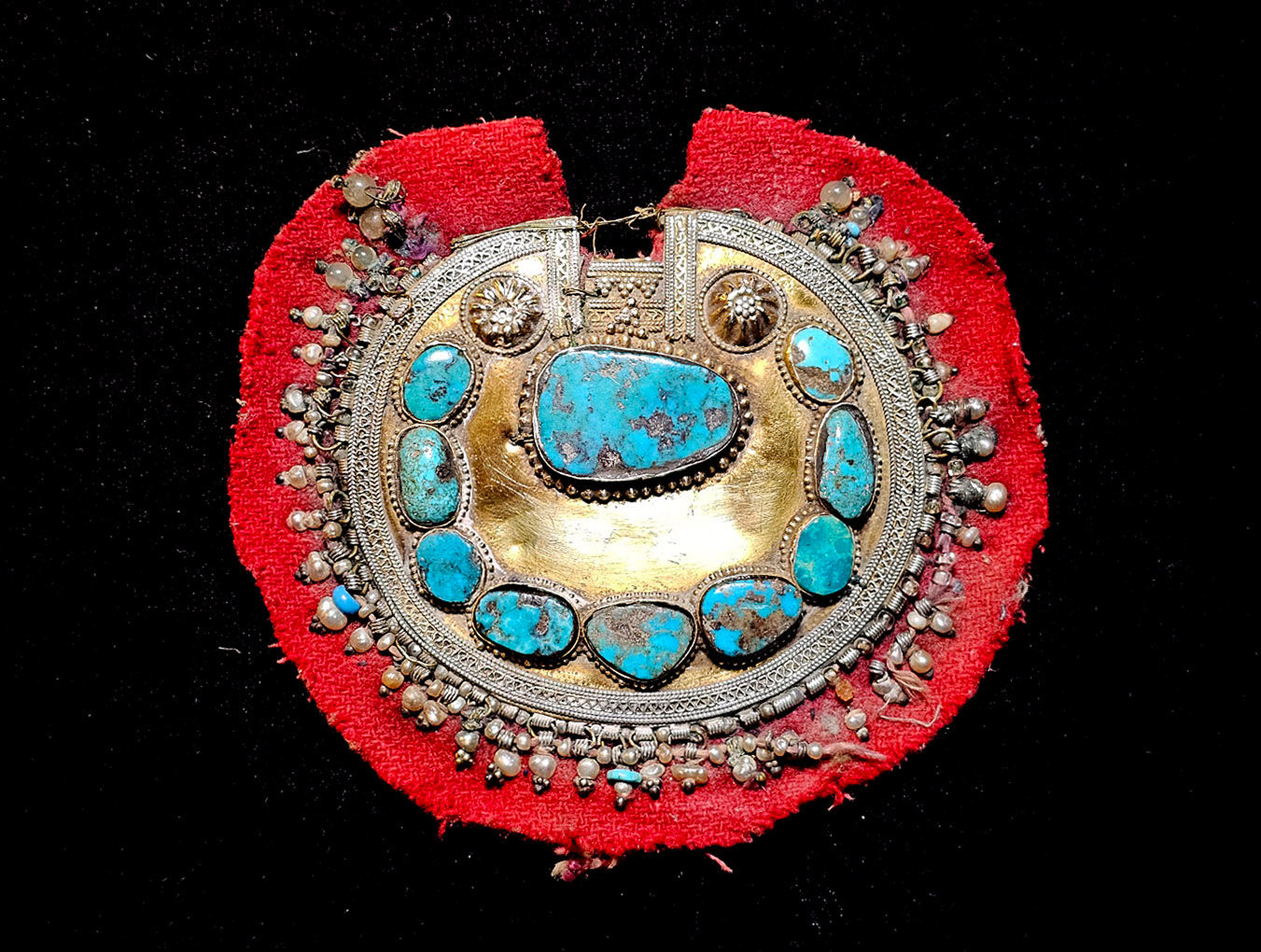

This exquisite piece is a historic Kaffa (also spelled Kaffat or known as Watya), a highly prized traditional forehead ornament worn by brides from the Najd region of central Saudi Arabia. Tested gilded silver (vermeil) wrapped in high-karat gold leaf.
The "10 Turquoise Inlays" of the Kaffa. A classic hallmark of a high-status Najdi bridal Kaffa is its meticulous configuration of gemstones. If you count the inset turquoise stones on the gilded disc of this specific heirloom, you will see exactly 10 pieces of turquoise:
1 large central stone acting as the focal point. 9 surrounding tablet-cut stones outlining the outer perimeter.
In traditional Arabian jewelry design, symmetry, abundance, and stone counts were deeply deliberate. The inclusion of 10 distinct turquoise elements served a dual purpose on a wedding day: The Amulet of Protection: Historically, turquoise (fayrouz) was widely chosen for Middle Eastern bridal dowries because it was believed to hold protective properties, shielding the new bride from the "evil eye" or envious glances during the wedding celebrations.
 A Display of Wealth: The dense clustering of 10 large, irregular turquoise matrices, combined with seed pearls along the fringe and a gold-leaf disc, demonstrated the bride's financial security and status
Key Traditional Features :Red Felt Backing: These delicate metal ornaments were traditionally sewn onto a thick crescent of red cloth or felt. This served a practical purpose (allowing the heavy metal to be pinned securely into the bride's braided hair or headdress without scratching the skin) while visually making the vibrant blue turquoise pop.
Intricate Granulation & Pearl Fringe: The bottom arc features cascading rows of wirework loops, tiny seed pearls some replaced later with non pearls, and metallic beads designed to dangle delicately over the forehead, catching the light as the bride moved. There is some wear and loss of thread to the lower part of the tiny beads.
Similar 19th and early 20th-century historical examples of this specific Saudi headpiece are preserved today in world-class institutional archives like the Metropolitan Museum of Art and the Dallas Museum of Art.Origin: Najd Region, Saudi Arabia (Arabian Peninsula)Period: Late 19th Century to Early 20th Century (Circa 1880–1920)
Metal: Solid Silver base, heavily gilded/plated in traditional High-Karat Gold leaf
Gemstones: 10 Authentic Khorassan Turquoise plaques (1 large central matrix, 9 surrounding hand-cut tablets)Fringe: Hand-wired mixed pearls some replaced later and delicate cascading metallic drop beads
Backing: Original structural red felt/cloth backing used to stitch the ornament securely into the hair
Dimensions: 10cms x 9cms (Including pearl fringe) Weight:64grams
 CONDITION REPORT This is a genuine, century-old antique in Excellent Antique Condition. It displays an exquisite, patina that highlights the mastery of the original Bedouin silversmith. The gold gilding remains remarkably bright and substantial. The natural turquoise stones show beautiful, authentic matrix variations.
The original red textile backing shows minor, expected age-related wear and fraying , which serves as definitive proof of its historical authenticity.
 INSURED SHIPPING & HANDLING
Due to the value and rarity of this antique, it will be packed with professional-grade archival materials.
