

Love or Fear? The Strange Story of a Rock Crystal Heart

You'd think this little heart was about love. But actually, it's about fear.
At least, that is where my research into this extraordinary little object has led me.
It's a heart of clear rock crystal, smoothly polished and mounted in silver. I bought it as seventeenth century and probably German — but, as I'll come to later, even the date has become part of the mystery. What does seem clear is that it belongs to a much wider European tradition of rock crystal amulets and protective objects.
In seventeenth-century Europe, fear itself could be dangerous, particularly the fears surrounding pregnancy, childbirth and the health of the child.

There was a widespread belief in the extraordinary power of a pregnant woman's imagination and emotions. Something she saw, or something that terrified her, could be thought to affect the child growing inside her. Her fear might leave a physical mark. Her emotional state might affect the child's health. It might even influence its temperament or character.
And I find that fascinating, because a woman's inner emotional world was being given this extraordinary physical power. Her emotions were believed capable of shaping another human being.
But imagine the burden of that. You weren't only frightened for your unborn child.
You could be frightened of the power of your own fear.
“She endangers her child”
And this wasn't some obscure belief. Once I started looking, I found people writing about it across Europe.
In England, as early as 1621, Robert Burton wrote about a pregnant woman being “affrighted and terrified by some fearful object, heard or seen.” He said “she endangers her child.” He believed the mother's imagination could act upon the unborn child and even “leave a mark upon it.”
And he gives extraordinary examples. He tells of a man born in Brandenburg who supposedly staggered throughout his life because, while pregnant, his mother had seen a drunken man staggering in the street. He also records the story of a pregnant woman at Wittenberg who was terrified by the sight of a corpse, with the appearance of her child later attributed to that fright.
The mother's experience — what she saw and how she reacted emotionally to it — was believed capable of being transferred to the unborn child.
Fifty years later, in 1671, the English midwife Jane Sharp was writing about the same thing. She wrote that sometimes a mother was “frighted” and the child “markt accordingly.” And she summed up the extraordinary power attributed to the mother's mind in four words:
“Imagination can do much.”

We find similar beliefs in the German-speaking world. The German surgeon Matthäus Gottfried Purmann recorded an extraordinary case from 1664. A servant had cut the head off a turkey. The severed head fell at the feet of a pregnant woman and terrified her. She instinctively put her hand to her forehead.
When her child was later born with an unusual growth on its forehead, it was said to resemble the head of the turkey. Her fright was blamed.
A woman's fear was believed powerful enough to leave its imprint on her unborn child.
A changing understanding of the body
What I find particularly interesting is that this was also a period of enormous enquiry and argument about pregnancy and the human body. Midwives and physicians were observing childbirth, recording what they saw and producing increasingly detailed illustrations of the child inside the womb.
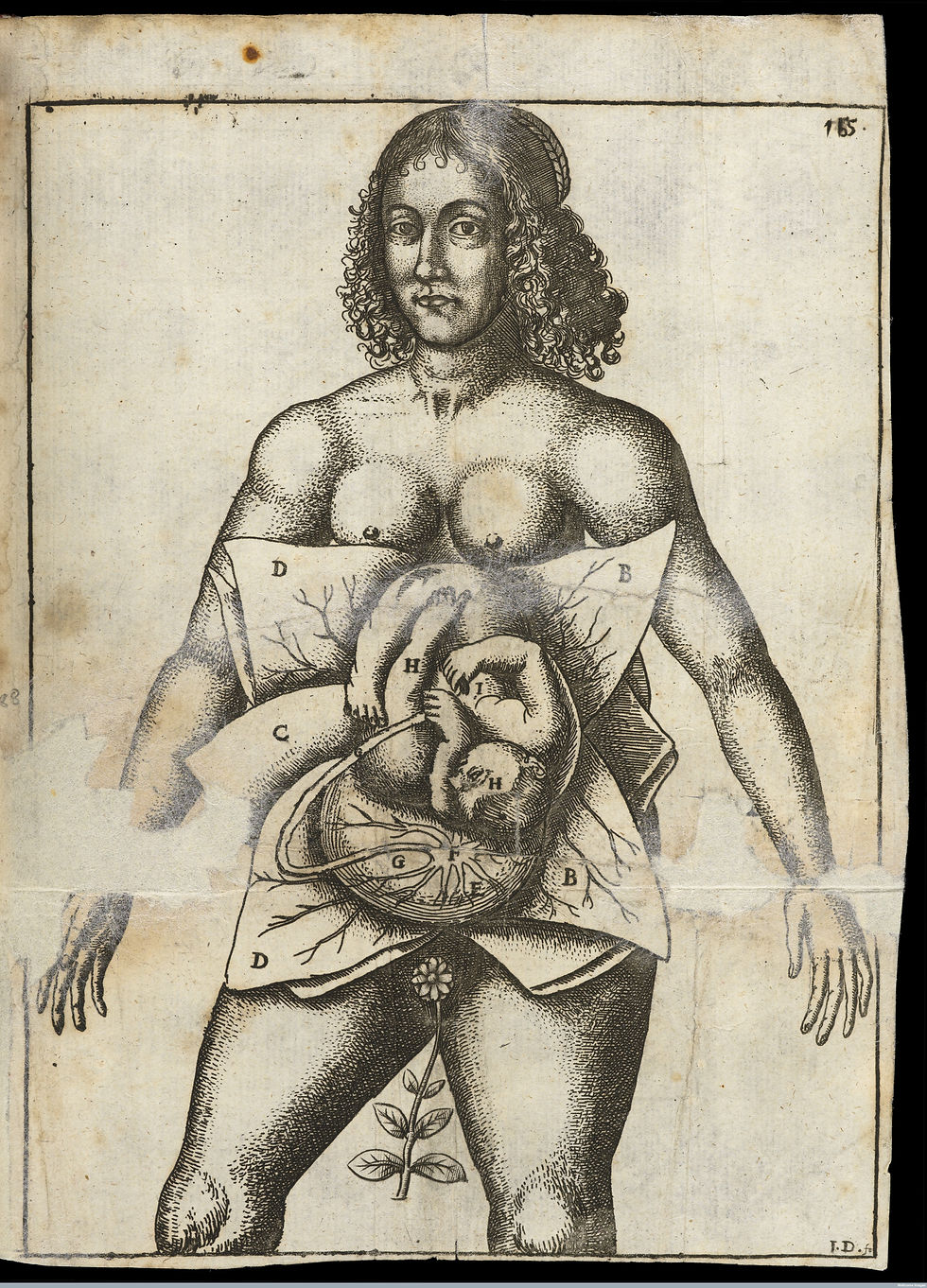
In Germany, Justina Siegemund's Court Midwife, published in 1690, contained detailed obstetrical illustrations based on the practical problems she encountered in childbirth.
So these weren't people who simply accepted everything without question. They were looking. They were observing. They were arguing.
And yet their understanding of the body was still profoundly influenced by ideas inherited from classical medicine. The four humours — blood, phlegm, yellow bile and black bile — and the qualities associated with them remained fundamental to ideas about health.
Hot and cold. Wet and dry.
The body was something whose balance could be affected by these qualities. And that makes one physical characteristic of this heart particularly intriguing.
Rock crystal is remarkably cold to the touch.
Put it against your skin and you feel it immediately. Today we understand that simply as a property of the material. In a world in which hot and cold had medical significance, however, the temperature of a stone worn against the body could be understood very differently.
Older ideas about the body, imagination, emotion and fear were existing alongside a growing desire to understand what was actually happening inside it.
And the belief in maternal imagination didn't simply disappear as medicine developed. It continued into the eighteenth century. The London physician Daniel Turner still argued that a mother's imagination really could affect the unborn child. Another physician, James Augustus Blondel, argued that it couldn't. They actually argued about it in print.
So this was a belief widespread and persistent enough to become part of a serious medical debate.
How do you protect yourself from fear?
Now imagine being a pregnant woman living in that world. If you genuinely believed that your own fear could harm your child, what could you do to protect yourself from something as intangible as fear?

And this is where the rock crystal heart becomes particularly interesting.
In the German-speaking world we find protective amulets known as Schrecksteine. Schreck means fright or fear. So these were quite literally fright stones — objects worn to protect against fright and the harm that fright was believed capable of causing.

And among the surviving examples are rock crystal hearts remarkably similar to this one. Some have clearly protective or devotional associations. Some combine rock crystal with Christian imagery.
So this little heart doesn't exist in isolation. There's a whole tradition sitting behind it.
Remarkably, that tradition continued for generations. A protective amulet chain from Salzburg dating from around 1790 still contains a heart-shaped rock crystal Schreckstein amongst a whole collection of protective charms. The purpose of these amulets was protection from fright and fear and from the illnesses those emotions were believed capable of causing.

And this is where all these different strands start to come together: the pregnant woman, the extraordinary power attributed to her emotions, the fear that those emotions could harm her child, and an object intended to protect against fright.
Why rock crystal?
For thousands of years, across many different cultures, rock crystal had been regarded as an amuletic and protective material.
There really is something extraordinary about it. It's completely clear. It's cold to the touch. It looks almost like frozen water. In fact, people once believed that rock crystal was water frozen so intensely that it could never melt.
Its extraordinary clarity also gave it associations with purity. Perhaps that was part of its power. Perhaps it was the enormous weight of belief that had accumulated around this material over centuries.
We simply don't know exactly why it was thought to work. But we do know that rock crystal was used as a stone against fright — something worn in the belief that fright would not do harm.
In a sense, it stood between the wearer and the consequences of fear.
And what can this heart itself tell us?
This is where I come back to the object. Because when an object has lost its original owner and history, the object itself has to provide the clues.
The rock crystal isn't faceted. It is smooth, rounded and plump, almost pebble-like. It fits beautifully into the palm of the hand. Around it is a silver mount with a distinctive toothed setting, and at the top is a suspension loop.
These are small details, but they're exactly the sort of details that matter when trying to understand when and where an object was made.
And they have presented me with a problem.
How old is this heart?
I bought it as seventeenth century. There are certainly rock crystal amulets attributed to the seventeenth century, and examples from the German-speaking world provide compelling comparisons.
But during my research I found a heart in Museum Schnütgen in Cologne which stopped me in my tracks. Its smooth, rounded rock crystal, toothed setting and overall construction are remarkably similar to mine.
And that heart is dated by the museum to the eighteenth century.
That doesn't make mine eighteenth century. But it does mean I don't think we should simply call it seventeenth century and stop looking.
Could it be seventeenth century? Could it date from around 1700? Could it be somewhat later?
The shape of the silver setting, the suspension, the way the stone has been polished and the construction of the mount may eventually help narrow that down. For the moment, the exact date remains an open question.
And I rather like that, because research shouldn't simply be about finding evidence to confirm what we already think. Sometimes the most interesting discovery is the one that makes us look again.
Something to hold onto
And then there is something about the smoothness of this heart that no photograph can quite convey. It fits beautifully into the palm. It could be worn close to the body. You could reach for it.
You could hold onto it when you were frightened.
Whether that was ever its purpose, of course, we cannot know. But it must at least have been comforting to touch.
And if you genuinely believed that your own fear might harm your unborn child, perhaps an object like this offered something extraordinarily important. When so much was beyond your control, perhaps it gave you the feeling that there was at least something you could do.
And I think I understand the need behind an object like this. Because when somebody you love is vulnerable, and there's so much you can't control, you want to do whatever you can to keep them safe.
So perhaps this little heart was about love after all.
And that's why I couldn't walk away from it.
Comments